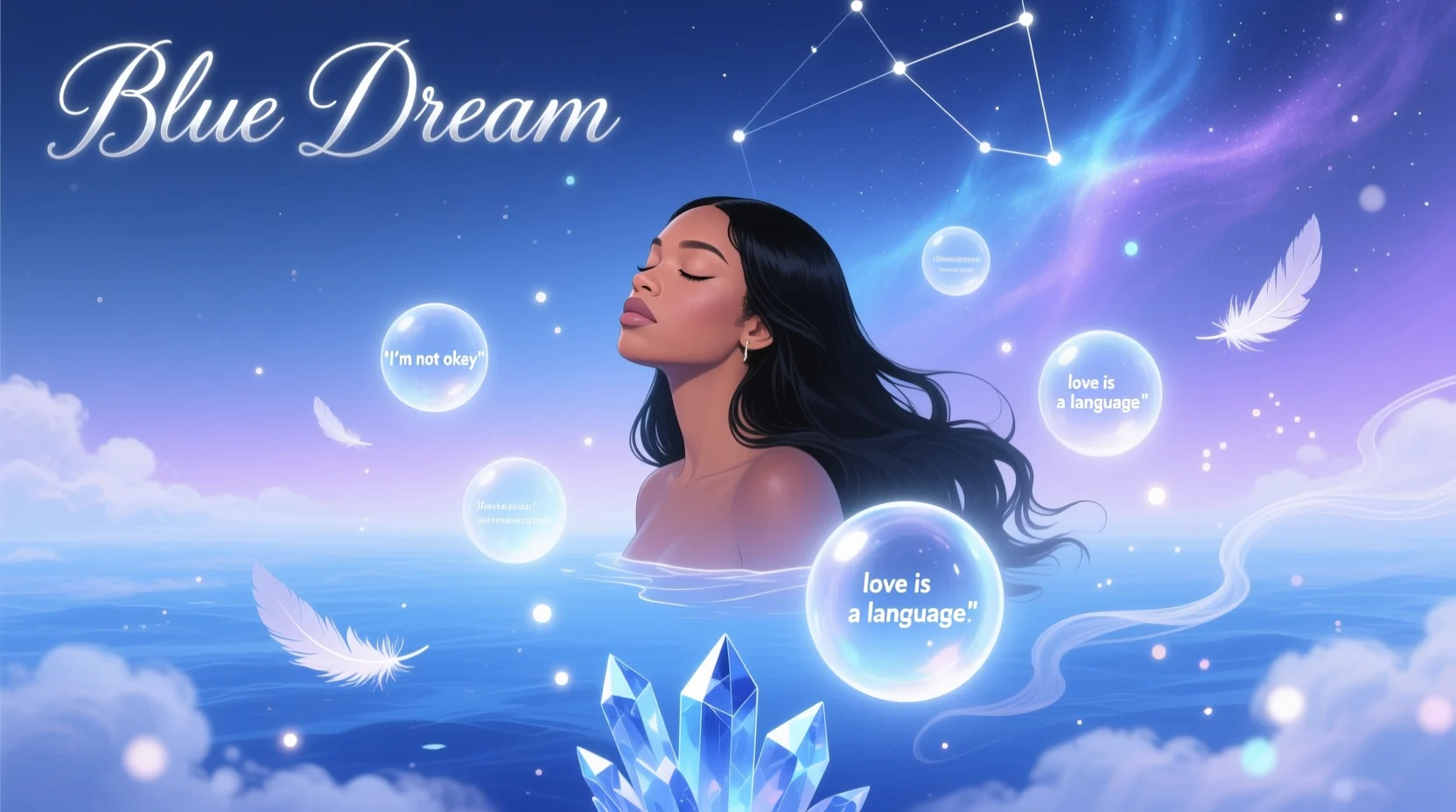
Picture this: you’re drifting along the coast at twilight, the ocean merging into the sky in a soft, endless horizon. In that moment you’re both awake and asleep — nothing quite feels real, yet you feel profoundly alive. That’s the world Jhené Aiko invites you into with “Blue Dream” — a place of shimmering emotion, quiet revelation and inner transformation.
In this world, the colour blue isn’t simply a shade — it’s an embodied mood: peace, yearning, depth, sorrow, transcendence. The “dream” she speaks of isn’t merely a nighttime fancy — it’s a state of the soul where love, healing and possibility merge. So what does Blue Dream mean, spiritually? Anthropologically? Psychologically? Symbolically? In this long-form article, we’ll dive into:
- historical and cultural roots of the imagery
- psychological and healing interpretations
- spiritual and religious perspectives
- deeper symbolism of strength, resilience, inner healing
- gender-based nuances of meaning
- the idea of placement and body-location (if this became a tattoo, design or personal rite)
- design and colour symbolism (blue and beyond)
- the cultural debate around appropriation, artistic metaphor and tradition
- real-life stories and examples for authenticity
- FAQs and a reflection-rich conclusion
Let’s embark on this “blue dream” together and see what it reveals.
Historical & Anthropological Background
The Blue Dream Motif Through Time
The notion of a “blue dream” merges two rich symbolic strands: one, the colour blue; two, the dream state. Historically, many cultures have revered blue as sacred or liminal. Many ancient traditions associated blue with the sky, water, infinite space, healing or otherworldly realms. The dream state likewise has long been seen as access to hidden layers of psyche or spirit.
In anthropology, dreams were not merely random mental chatter — they were often ritual portals. Indigenous communities sometimes read dreams as messages, warnings or cleansings of the unseen world. When you combine the deep blue of water/sky with the dream realm, you get a motif that implies going beyond everyday reality, into the hidden, emotional-spiritual landscape.
Over time, the concept of “dreamlike states” shifted into artistic and musical metaphors: escape, transformation, altered consciousness. In modern settings, the term “blue dream” also happens to reference a well-known cannabis strain. Some critics suggest Jhené Aiko’s title plays on this double meaning (both escape and transcendence). Yet underlying all that remains the ancient impulse: to journey inward, to heal, to dream in colour.
Cultural Contexts & Spread
- In Western popular culture, the phrase “blue dream” evokes both sublime calm and melancholy.
- In African-diaspora musical traditions (R&B, soul, neo-soul) the dream motif often articulates longing, transcendence and spiritual yearning. Jhené Aiko draws deeply from those wells.
- On a global level, the idea of love as a “dream” (something other-worldly, transformative) is cross-cultural: from Hindu bhakti poetry to African oral traditions, from Native American vision-quest dreaming to modern spiritual music.
Thus the song Blue Dream doesn’t just ride a catchy metaphor — it taps into a rich tapestry of human symbolic practice: love as dream, colour as feeling, soul as journey.
Psychological & Healing Interpretations 🧠
What the Psyche Might Be Saying
From a psychological lens, Blue Dream offers many layers:
- Dream-state as psyche’s metaphor: According to Jungian psychology, dreams and dream‐imagery reveal what is not yet conscious. The “blue dream” could symbolize an inner space where suppressed emotion, intuition or potential is surfacing.
- Colour blue & emotional healing: Studies show that blue light and blue tones often evoke calm, reduce anxiety and foster introspection. In the song, the blue dream state may represent an emotional healing space or restful inner refuge.
- Love as remedy & expansiveness: The lyrics speak of the beloved as “the remedy for everything” and the mind opening so wide. Psychologically this can mean that a relationship (or an inner aspect of self) becomes a catalyst for growth, expansion and re-orientation away from mere survival.
- Escapism vs integration: Some interpretations suggest the “blue dream” also hints at escapism (perhaps via substances) or altered states. But a healthier reading sees it as integration: using the dream space to turn inward and transform.
Healing Frameworks
If you resonate with this song, consider these heuristic pointers:
- Journal the “blue moments”: When did you feel “blue” in the sense of calm/longing? What dream-states (literal or metaphorical) have you visited?
- Track colour-emotion links: When you see blue in your life (clothing, water, sky) what emotions emerge?
- Use the song as meditative door: Play Blue Dream, close your eyes, and ask: What part of me is opening? What is seeking peace?
- Therapeutic possibility: In counselling or art therapy, the “blue dream” motif may serve as a safe container for exploring attachment, longing, healing and the re‐awakening of self.
In short: Blue Dream invites you to feel your feeling, to expand your mind, and to heal inwardly by dreaming outward.
Spiritual & Religious Perspectives ✨
Cross-Cultural Spiritual Readings
- Native & Indigenous symbolism of blue: In many Native American traditions, blue (especially sky-blue) is linked to sacredness, spiritual protection, the realm of the Gods or ancestors. A “blue dream” in that sense may be a vision, a spiritual encounter, a calling.
- Eastern spirituality: In Hinduism, the colour blue is associated with deities like Krishna or Vishnu — embodying love, cosmic guardian energy, transcendence. Dreams are often read as messages from the Self or the Divine. Thus “blue dream” can hint at a divine love or soul alignment.
- Modern spiritual/new-age view: The dream becomes a metaphor for inner alignment. The beloved may represent not just another person, but your higher self. The “blue dream” is the soul awakening to its truth.
- Christianity-adjacent metaphors: Though less explicit in the song, one could interpret the beloved’s “remedy for everything” as Christ-like symbolism — love as redemption. The dream realm becomes the sacred harbour away from world chaos.
Symbolic Themes
- Protection: The dream‐space and the colour blue act as a protective vessel for the vulnerable “you”.
- Resurrection & inner renewal: Out of sorrow or struggle emerges the blue dream space where healing occurs.
- Intuition & communication: Blue corresponds to the throat chakra (in some esoteric systems) – truth, soul‐voice, expression. The dream may be inviting you to speak your truth, open your heart.
- Alignment with soul’s path: The dream state prompts, “Are you living the life you are meant for?”
In this way, Blue Dream becomes more than a song: it is a spiritual anthem for those who feel the pull of something beyond themselves.
Deeper Symbolism: Strength, Resilience, Protection, Inner-Healing
Strength & Resilience
Though the song is soft and dreamy in tone, under its surface lies resilience: to open one’s heart, to risk vulnerability, to stand in love. A blue dream isn’t naïve—it’s courageous. It’s saying: I will dream even though I might wake into pain.
Protection
The dream circle becomes a safe-zone. The beloved, the dream-state, the colour blue—they all act like guardians of your inner world. Entering a blue dream means creating a boundary around your most tender self.
Inner-Healing
Love opens doors. The lyrics “my mind is open so wide since you came inside” speak of transformation—not just being seen, but being awakened. The blue dream thus becomes a symbol of healing: from numbness, from disconnection, from old wounds.
Unfolding Potential
The motif of horizon where “ocean is holding the sky” (lyrics) suggests tying together earth and ether, the finite and infinite. It invites you to expand your capacity, to move beyond circumstances, to perceive your life as something larger than your hurts.
Gender-Based Meanings (Masculine vs. Feminine Energies)
Feminine Energy Interpretations
For the feminine (in all people), Blue Dream may represent:
- the softening of armour, allowing vulnerability;
- the recognition that healing love is both gentle and powerful;
- the return to self after losing oneself in others.
The dream realm becomes a womb-space, a nurturing field where the self recovers.
Masculine Energy Interpretations
For the masculine, this song may invoke:
- the invitation to feel, to stop suppressing emotion;
- the realisation that strength lies not just in control but in openness;
- the chance to awaken the part of you that wants connection and meaning.
In dreaming blue, the masculine energy learns the dance of gentleness and presence.
Balanced View
Rather than pigeonholing by gender, the song offers a union: feminine and masculine energies held in dream-space, healing together. If this became a personal symbol (e.g., a tattoo), one might see it as integration of both polarities: the logic and the feeling, the doing and the being.
Placement & Body-Location Meanings (Hand, Thigh, Chest, Back, etc.)
If one were to translate the metaphor of Blue Dream into a body-placement symbol (e.g., tattoo, ritual mark, or personal rite) the location would matter. Consider these options:
- Chest (over heart): Reflects the dream of love, the heart-opening invoked by the song.
- Back (upper back): Represents carrying the dream-state quietly; the horizon behind you, the wide open sky.
- Thigh or hip: More personal, intimate; the hidden world of self, the ground from which movement arises.
- Hand or forearm: A visible place – perhaps a declaration that you live in the dream, you channel the vibe of the song outward.
- Side ribs / under-arm: The liminal zone between structure and openness – an edge where transition happens.
Choosing a placement invites reflection: Where in my body do I carry the dream? Where do I hold the blue horizon?
Design & Colour Symbolism 🎨
Colour Blue and Beyond
Here’s a breakdown of design and colour symbolism you might draw from Blue Dream:
| Colour | Meaning in this context |
|---|---|
| Blue | Peace, intuition, water-depth, spiritual connection, clarity |
| Green | (Mentioned in lyrics: “green eyes”) growth, renewal, life |
| White | Purity, illumination, threshold of insight |
| Silver | Dream-light, moon-glow, subtle awakening |
| Gold | Sacred love, rare truth, value beyond the ordinary |
Design Elements
- Horizon line / ocean + sky merge: Represents the meeting of finite and infinite; the moment of revelation.
- Dream-cloud or ethereal texture: Suggests transience, fluidity, the liminal space between sleep & awake.
- Eyes / gaze motif: “Green eyes” evoke recognition, seeing, being seen.
- Water / wave imagery: Emotional depth, flow, cleansing.
- Script phrase “Blue Dream” or symbolic glyph: A simple label can become a mantra or marker of personal truth.
Putting it all together: a tattoo of a soft blue horizon, subtle wave line, maybe a hint of green-eyed gaze, placed on your chest or side — could symbolise I live in my blue dream, I open to love, I speak my truth.
Cultural Debate: Respect vs. Appropriation
When using dream, colour and spiritual symbolism (especially drawn from Indigenous or non-Western traditions) we must tread with care. A few points:
- Dream traditions of many Indigenous peoples treat dreaming as sacred — guidance, ancestors, rites. Borrowing these symbols casually can trivialise their depth.
- The blue dream motif in pop music is a creative metaphor — but when translating into tattoos, rituals or spiritual practice, one should acknowledge origins and not claim “ownership” of culturally specific symbols.
- Many spiritual-metaphor systems (chakras, colour correspondences) actually derive from South Asian or East Asian traditions. If you engage with them, it’s respectful to learn context, give credit, adapt mindfully.
- The phrase “Blue Dream” also references a cannabis strain — a modern cultural footnote that blends with older spiritual meanings. If you use it symbolically, be clear you’re using it metaphorically, not endorsing substance use.
In short: honour the dream space, honour the tradition, honour yourself.
Real-Life Stories or Examples
Story 1: Someone who found solace
A listener shared:
“When I heard Blue Dream after a breakup I felt like I was floating out of my pain. I closed my eyes, let the blue swell around me, and realised my heart was bigger than the hurt.”
This story echoes the healing dimension of the song — love and self-love merging in the blue dream space.
Story 2: Tattoo as affirmation
Another fan chose to tattoo a soft, minimalist horizon line in blue ink across her ribcage, with small green‐eyed gaze symbols at each end. Her intention: “to remember that love opens me, the dream finishes me.” Every time she looks in the mirror, she remembers the journey.
Story 3: Dreaming into healing
In a therapy session, a client described recurring dreams of floating above an ocean at dusk — the water deep, the sky turning violet-blue. They’d listen to Blue Dream before sleep and journal their after-images. Over weeks, their nightmares faded and they described themselves as entering their own “blue dream” — a private space where they could feel safe, seen and healing.
These real-life instances show how the song becomes more than entertainment — it becomes a portal, a symbol, a lived experience.
FAQs
Q1: What does the “blue dream” metaphor mean in the song?
A1: It refers to a state of love, peace and transformation — where the narrator is still in a dream-state of bliss and connection, not wishing to wake because the dream feels truer than normal life.
Q2: Is there a drug reference in “Blue Dream”?
A2: Some interpretations note that “Blue Dream” is also the name of a cannabis strain, and there are subtle lyrical hints of escape. However, spiritually the song emphasises the heart-space, the emotional truth, and doesn’t reduce the metaphor to just a substance.
Q3: How can I apply the song’s meaning to my life?
A3: Use the song as an introspective tool — listen with awareness, journal how the colours and emotions make you feel, ask yourself: Where am I living half-awake? Where does my soul still dream?
Q4: If I get a tattoo inspired by “Blue Dream”, what should I consider?
A4: Think of placement (chest for heart, back for past, hand for expression), colour palette (blues, greens), design elements (horizon, wave, eyes). Also reflect on personal meaning — a tattoo is more than art, it becomes a living marker of your journey.
Q5: What is the spiritual lesson of “Blue Dream”?
A5: That love (to self or other) can be a portal into deeper truth; that we don’t have to wait for perfect conditions to dream; that the dream may feel fragile but is powerful. The spiritual ask: open your heart, expand your mind, trust the horizon is larger than you thought.
Conclusion: Dream Bigger, Dream Blue
When you first press play on Blue Dream, you may hear a soft groove, a gentle R&B vocal. But dive deeper — you’ll find a dream-ocean, a horizon of possibility, a call to awaken. Jhené Aiko doesn’t sing merely of love; she sings of being moved by love, opening to the infinite, dwelling in the dream until you become the dreamer.
Your life might be full of noise, expectation, pressure. The “blue dream” invites you to pause, float, breathe, remember: You are more than your circumstances. You are horizon-open. You are heart-awake.
Whether you carry this song in your headphones, on your skin (tattoo) or in your psyche, let it remind you: love is not just something that happens to you. It is something you become. The dream is not external. The dream is you, emerging in blue light, clarity and truth.
Go ahead — float a little longer. Feel the blue around your edges. Don’t rush to wake. Because in that dream you might find the part of you that’s been waiting to remember: you are the remedy, you are the dream, you are the horizon. 🌊💙