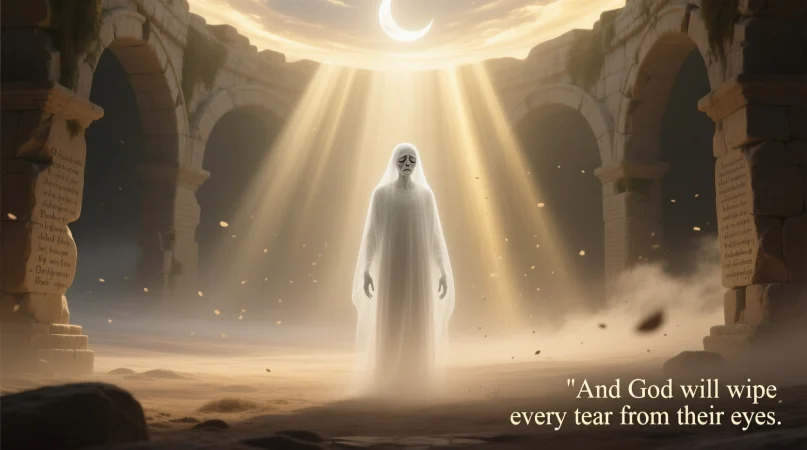
You’re standing in a quiet place — perhaps a childhood home, an empty street, or a dimly lit room. Suddenly, you see someone who passed away long ago. They look real, almost alive. Their eyes meet yours, but their lips never move. No words. Only silence.
You wake up with your heart heavy and mind full of questions:
Why didn’t they speak? What does this silence mean in a biblical sense? Was it a warning, a message, or a spiritual sign?
Dreaming of a dead person not talking to you is one of the most emotionally charged dream experiences. Biblically, silence carries profound symbolism: reflection, warning, spiritual distance, or divine mystery.
This article explores the biblical meaning, psychological interpretation, spiritual symbolism, emotional depth, and cultural perspectives behind this dream — helping you understand what your spirit is trying to tell you.
📜 Historical & Anthropological Background
🏺 Dreams in Ancient Cultures
For thousands of years, humans have believed that dreams allow communication with the spiritual world — especially with ancestors or deceased loved ones.
- Ancient Hebrews considered dreams as one of God’s channels to deliver warnings or guidance.
- Babylonians and Egyptians believed the dead could appear in dreams to reveal secrets or future events.
- Greek and Roman cultures saw silent dream encounters as omens related to unfinished matters or divine intervention.
In ancient societies, silence in dreams wasn’t meaningless — it was a message wrapped in mystery.
✝️ Biblical Views on Dreams of the Dead
The Bible does not encourage communication with the dead directly, but it does acknowledge that dreams can contain:
- Warnings (Job 33:14–15)
- Symbolic messages
- Spiritual revelations
- Emotional reflections
Silence in a dream often carried a message of:
- Separation
- Spiritual caution
- Mourning
- Transition
- God’s hidden guidance
This sets the foundation for interpreting this dream biblically.
🧠 Psychological & Healing Interpretations
From a psychological point of view, dreaming of a deceased person who does not talk to you often reflects:
❤️🩹 Unresolved Grief
You may still be processing their loss. Silence represents unfinished emotions or questions.
🤐 Guilt or Regret
Perhaps there were things you wish you had said — or you feel they left without closure.
🪞 Inner Reflection
The silent person may represent:
- A part of yourself you’re ignoring
- A message your mind is not ready to hear
💭 Memory Activation
Your brain is revisiting stored memories without forming a verbal narrative — producing non-verbal dream interactions.
🧘 Emotional Protection
Sometimes the brain keeps the person silent to protect your heart from overwhelming emotion.
✝️ Biblical & Spiritual Perspectives
Here are the main biblical meanings of dreaming of a dead person not talking to you:
1️⃣ A Symbol of Spiritual Distance
Silence often represents separation — not only physically but spiritually.
In the Bible, silence can mean:
- A barrier
- A closed chapter
- A transition
- A divine boundary
The dead person’s silence may be God’s way of reminding you that the living should not seek direct conversations with the dead (Deuteronomy 18:10–12).
2️⃣ A Divine Warning or Caution
Sometimes silence is protective.
Biblically, God often uses silence to:
- Halt harmful communication
- Prevent deception
- Redirect the dreamer
The silence may be God saying:
“Do not follow this path — stay focused on the living and on Me.”
3️⃣ A Sign of Unfinished Emotional Healing
Even though the person is not speaking, their presence may signal:
- Unresolved emotions
- Unforgiveness
- Grief that needs healing
- Personal transformation
This dream can be an invitation to seek peace, prayer, and forgiveness.
4️⃣ A Message About Closure
Biblically, silence may symbolize that:
- A chapter of your life has ended.
- God is closing a door for your emotional or spiritual well-being.
- You must move forward without relying on the past.
Their silence may be saying:
“Your healing is meant to come from God — not from me.”
5️⃣ A Reminder of Mortality & Spiritual Priorities
The Bible frequently uses encounters with the deceased (in visions or symbolic dreams) to remind people to:
- Evaluate their life
- Strengthen their faith
- Focus on righteousness
- Remember what truly matters
The silent presence may simply be a spiritual wake-up call.
🌌 Deeper Symbolism: Silence, Loss & Divine Mystery
The dream carries emotional and symbolic layers:
🕊️ Silence as a Message
Sometimes the absence of a message is the message.
🔗 Unfinished Bonds
Your soul may still feel connected to them.
🌫️ Divine Mystery
God often works in subtle, symbolic ways — silence included.
💔 Fear of Letting Go
The dream may show your reluctance to release their memory.
💡 A Call to Self-Reflection
Their silence can feel like a mirror, prompting you to ask:
What part of my life needs healing, forgiveness, or change?
⚧ Gender-Based Meanings
👩 If the dreamer is a woman:
The silent dead person may represent:
- Emotional vulnerability
- A past relationship or role that shaped her identity
- A need for closure
- Fear of abandonment
👨 If the dreamer is a man:
It may symbolize:
- Guidance he wishes he still had
- Emotional suppression
- A past responsibility or regret
- Spiritual redirection
🕉️ Placement & Body Location Meanings (Tattoo Symbolism)
Even though the dream is not directly about tattoos, here is a symbolic breakdown:
| Placement | Meaning |
|---|---|
| ✋ Hand/Wrist | Seeking connection or communication from the past |
| 💖 Chest | Deep emotional grief or attachment |
| 🔙 Back | Past memories influencing your present |
| 🦵 Thigh/Leg | Movement toward closure or healing |
| 🧠 Head/Neck | Spiritual messages, unresolved thoughts |
🎨 Color & Design Symbolism
If the dead person in the dream appears with specific colors, these may carry symbolic meaning:
| Color | Symbolism |
|---|---|
| 🤍 White | Peace, spiritual protection, divine presence |
| 🖤 Black | Mourning, fear, unresolved issues |
| 💙 Blue | Healing, truth, emotional calm |
| ❤️ Red | Passion, guilt, or emotional shock |
| 🌫️ Grey | Ambiguity, confusion, spiritual transition |
🪶 Cultural & Religious Debate
In Christianity, contacting the dead is strictly forbidden.
However:
- Many cultures see dreams of ancestors as blessings
- African, Asian, and Indigenous traditions view silent ancestors as protectors
- Some believe silence means “watching over, not intervening”
The biblical view prioritizes spiritual safety, while many cultures emphasize ancestral connection.
🌠 Real-Life Stories & Experiences
📘 Maria’s Story
Maria dreamed of her grandmother standing silently beside a river. For months she wondered why she didn’t speak. Later she realized the dream came during a time of emotional burnout — the silence was a sign to slow down and find peace.
📘 Daniel’s Dream
Daniel saw his deceased father in a crowded room. His father looked at him but remained silent. Therapy revealed Daniel still carried guilt for not reconciling before his father’s death. The dream was the start of his emotional healing journey.
❓ FAQs
1. Is it a bad sign biblically if a dead person is silent in my dream?
No. Silence often symbolizes protection, boundaries, or emotional healing.
2. Does their silence mean they are angry at me?
Not necessarily. Usually, silence reflects your emotions — not theirs.
3. Could this be a spiritual warning?
Possibly. Biblically, silence can be a caution to focus on God, not the dead.
4. Is the dream telling me not to seek answers from the past?
Often yes — it may be encouraging you to move forward spiritually.
5. Does this mean the dead person is trying to communicate?
Biblically, communication with the dead is not encouraged. The dream is symbolic, not literal.
🌄 Conclusion: Silence That Speaks
Dreaming of a dead person who does not speak to you is powerful — not frightening, but deeply spiritual.
Biblically and emotionally, this silence may be:
- A protective boundary
- A call for reflection
- A message to seek closure
- A reminder to rely on God
- A gentle nudge toward healing
Sometimes, silence carries the clearest message of all:
You are ready to move forward, heal, and grow.