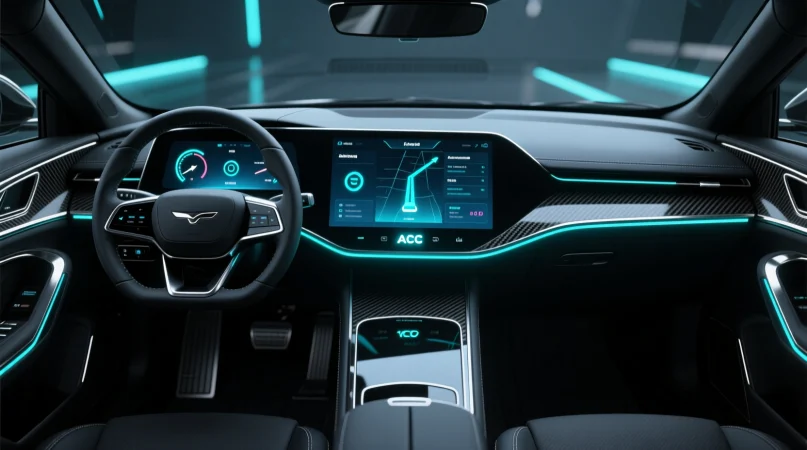
If you’ve ever glanced at your car dashboard and noticed a symbol or letters like “ACC”, you might have paused and wondered what it stands for. Is it something serious? Or just a simple car feature? Don’t worry — you’re not alone. Many drivers see “ACC” for the first time and get confused about whether it’s a warning or a helpful function.
Quick Answer:
In cars, “ACC” usually stands for Adaptive Cruise Control. It’s a driver-assist feature that automatically adjusts your speed to maintain a safe distance from the vehicle ahead. It’s not a warning — it’s a convenience and safety feature.
What Does ACC Mean in a Car?
ACC, or Adaptive Cruise Control, is an advanced version of traditional cruise control. While regular cruise control keeps your car at a fixed speed, ACC uses sensors to detect vehicles in front of you and adjusts your speed automatically to maintain a safe following distance.
Example:
“I turned on ACC on the highway, and my car automatically slowed down when traffic ahead reduced speed.”
In short:
ACC = Adaptive Cruise Control = Automatic speed adjustment for safer driving
Where Is ACC Commonly Used in Cars?
ACC is a feature available in modern vehicles, mostly in mid-range to high-end models. You’ll see it:
- 🚘 On highways for smooth, long-distance driving
- 🛣️ In stop-and-go traffic on busy roads
- 🌟 On cars with driver-assist packages
- 📊 Integrated into the car’s digital dashboard
Tone:
- ✅ Helpful, convenience-oriented
- ✅ Safety feature
- ❌ Not a warning sign
- ❌ Not a problem unless the system indicates a malfunction
Examples of ACC in Action
A: “I just activated ACC on my sedan.”
B: “Nice! That makes highway driving so much easier.”
A: “Traffic slowed down, but my car adjusted itself automatically.”
B: “Exactly! That’s ACC doing its job 😎”
A: “Do I still need to brake manually?”
B: “Yes, ACC helps but you’re always in control.”
A: “It kept a safe distance from the car ahead.”
B: “That’s the adaptive part — very handy on highways.”
A: “Can I use it in the city?”
B: “Mostly useful on highways and smoother roads, not stop-and-go traffic.”
When to Use and When Not to Use ACC
✅ When to Use
- On highways for long drives
- In light or moderate traffic
- For maintaining consistent speed safely
- During road trips or commuting
❌ When NOT to Use
- In heavy stop-and-go city traffic
- On slippery roads (ice, snow, rain)
- On winding or hilly roads
- In complex driving conditions where manual control is safer
Context Comparison Table
| Context | Example Phrase | Why It Works |
|---|---|---|
| Highway Driving | “I set ACC to 65 mph.” | Smooth, convenient cruise control |
| City Driving | “ACC engaged in traffic.” | Not recommended in heavy traffic |
| Parking / Short Trips | “ACC off.” | Feature not designed for low-speed maneuvering |
Similar Car Features or Alternatives
| Feature | Meaning | When to Use |
|---|---|---|
| Cruise Control | Maintains constant speed | Highway driving |
| Lane Keeping Assist | Helps stay in lane | Highway and long drives |
| Blind Spot Monitor | Alerts of vehicles in blind spots | Lane changes |
| Automatic Emergency Braking | Auto brakes if collision detected | All driving conditions |
| Traffic Jam Assist | Combines ACC & lane keeping | Stop-and-go traffic |
| Speed Limiter | Prevents exceeding set speed | Urban areas, speed control |
FAQs
1. Is ACC dangerous?
No, it’s designed to assist drivers, but you should remain alert.
2. Can I rely fully on ACC?
No, it’s a convenience feature. You must always be ready to control the car.
3. Does ACC work in all traffic conditions?
It works best on highways and smooth traffic; heavy city traffic reduces efficiency.
4. Will ACC brake my car automatically?
Yes, it can slow down to maintain a safe distance, but full stops depend on the system.
5. Is ACC available in all cars?
No, it’s typically in modern mid-range to premium vehicles with driver-assist features.
6. How is ACC different from normal cruise control?
ACC automatically adjusts speed to maintain distance; regular cruise control keeps a fixed speed.
Conclusion
ACC (Adaptive Cruise Control) is a smart driving aid that makes long drives and highway trips safer and more convenient. By automatically adjusting speed based on traffic ahead, it reduces stress and helps maintain proper spacing.
Remember, it’s not a replacement for attentive driving, and it’s best used in appropriate conditions like highways or steady traffic. Understanding ACC ensures you can use it effectively and drive smarter and safer.