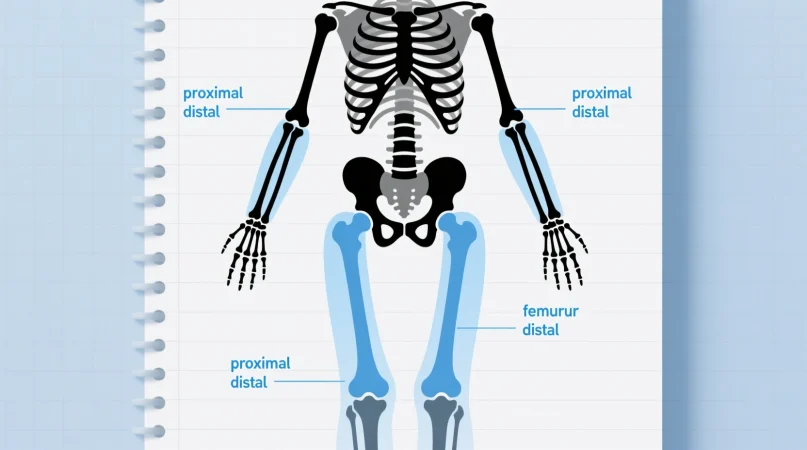
If you’ve ever watched a medical drama, opened a biology textbook, or overheard gym trainers talking, you’ve probably stumbled across the word “proximal.” I still remember the first time I heard it during a YouTube anatomy lesson — the instructor kept saying “proximal end, proximal part,” and I sat there wondering if it was some high-level medical spell from Harry Potter. Don’t worry — if you’ve been confused by it too, you’re definitely not alone.
Quick Answer:
“Proximal” means “closer to the point of origin or the center of the body.” It’s a scientific and anatomical term used to describe relative position.
What Does “Proximal” Mean in Text?
“Proximal” is an anatomy and biology term used to describe a body part that is closer to the torso, point of attachment, or central structure compared to another part.
Think of it like directional vocabulary for the body:
- The shoulder is proximal to the elbow.
- The hip is proximal to the knee.
It simply tells you which part is nearer to the starting point.
Example Sentence:
“The proximal end of the bone connects to the shoulder joint.”
In short:
Proximal = Near the origin = Closer to the center of the body.
Where Is “Proximal” Commonly Used?
This word shows up all the time in scientific fields, especially:
- 🧬 Biology class notes
- 🩻 Medical textbooks
- 🧑⚕️ Doctor explanations
- 🏋️♂️ Sports science and physiotherapy
- 🧪 Lab reports
- 📚 Research papers
- 🦴 Anatomy illustrations
It is a formal, academic term, not typically used in casual texting unless someone is joking or discussing something medical.
Examples of “Proximal” in Conversation
A: “my physio said the pain is in the proximal part of my arm??”
B: “means the part closer to your shoulder 👍”
A: “where’s the proximal segment of the tendon?”
B: “the part near the muscle attachment.”
A: “they said the fracture is proximal, is that bad?”
B: “just means it’s closer to the joint.”
A: “proximal vs distal always confuses me 😭”
B: “proximal = near, distal = far.”
A: “can u explain this diagram? says proximal end.”
B: “it’s the end closer to the center of the body.”
When to Use and When Not to Use “Proximal”
✅ When to Use
- Academic writing
- Biology or anatomy classes
- Medical student discussions
- Fitness injury explanations
- Research or lab work
❌ When NOT to Use
- Casual chats
- Non-medical conversations
- Slang or humor (unless intentional)
- Formal emails outside medical/science contexts
- Conversations where simpler words like “nearer” work better
Context Comparison Table
| Context | Example Phrase | Why It Works |
|---|---|---|
| Science Class | “The proximal section is nearer to the body.” | Accurate academic language |
| Doctor-Patient Talk | “Your pain is in the upper, closer part of the arm.” | Simple, patient-friendly |
| Research Paper | “Proximal tibia samples were collected…” | Professional & precise |
| Casual Chat | “The near part of your leg hurts?” | Everyday language |
Similar Terms or Alternatives
| Term | Meaning | When to Use |
|---|---|---|
| Distal | Farther from the body’s center | Anatomy & biology |
| Anterior | Front side of the body | Medical contexts |
| Posterior | Back side of the body | Clinical exams |
| Superior | Above another structure | Academic/scientific writing |
| Inferior | Below another structure | Anatomical descriptions |
| Medial | Toward the midline | Detailed anatomy explanations |
FAQs
1. Is “proximal” only a medical term?
Mostly, but it also appears in biology, kinesiology, and research.
2. What is the opposite of proximal?
“Distal,” which means farther from the point of origin.
3. Can you use proximal in everyday language?
You can, but most people simply say “closer” or “nearer.”
4. Does proximal always refer to the body?
In most cases yes, but it can also mean “near the start” of anything (like a river or pathway).
5. Is the shoulder proximal to the hand?
Yes — the shoulder is much closer to the body’s center.
6. Why do doctors use this term?
It provides exact, standardized direction, reducing confusion.
7. Can “proximal” be used emotionally (e.g., proximal relationship)?
Rarely. It’s mainly a physical term, not a metaphorical one.
Conclusion
“Proximal” might sound like a complicated medical term, but it simply means closer to the body’s center or point of origin. Whether you’re studying anatomy, talking to a doctor, preparing for an exam, or trying to understand a fitness report, this word helps describe physical position clearly and precisely. Once you learn it, you’ll instantly recognize it in diagrams, lectures, and explanations — and you’ll finally stop confusing it with “distal.” It’s a small term that makes a big difference in understanding how the body is mapped.